
How to Choose the Right Shim Set for Maintenance, Alignment, Assembly, and Industrial Applications
When aligning a motor, leveling machinery, assembling equipment, or making a precision adjustment, having the right shims available can make maintenance and production work faster and more consistent.
For many industrial teams, the question isn’t simply “What shim do I need?” It is also:
“Should I buy individual shims, a shim kit, or shim stock?”
The answer depends on the application, the required thicknesses, the material, and how frequently the shims will be used.
What Is a Shim Kit?
A shim kit is an assortment of shims provided in multiple thicknesses, sizes, shapes, or materials for use across different applications.
Instead of purchasing a single shim for one specific adjustment, a kit gives technicians access to several commonly needed options.
Shim kits can be useful for:
-
- Machinery alignment
- Equipment installation
- Maintenance and repair
- Motor and pump alignment
- OEM assembly
- Tooling adjustments
- General industrial maintenance
The right kit depends on the types of equipment and adjustments your team performs.
Why Keep a Shim Kit in Your Maintenance Inventory?
A missing shim can turn a relatively simple adjustment into a purchasing delay.
Keeping commonly used shim sizes and thicknesses available can help maintenance teams:
-
- Reduce time spent sourcing individual parts
- Complete adjustments faster
- Avoid cutting shim stock during routine work
- Standardize commonly used materials
- Improve technician consistency
- Keep critical maintenance supplies on hand
For facilities with recurring alignment and adjustment work, a well-organized industrial shim kit can become a useful part of the maintenance inventory.
What Types of Shims Are Used in Machinery?
There is no single shim that works for every industrial application. Different equipment and adjustment requirements call for different configurations.
Metal Shims
Metal shims are commonly used where strength, durability, and dimensional stability are important.
Common materials include:
-
- Stainless steel
- Aluminum
- Brass
- Other specialty metals
Stainless steel is often selected for applications where corrosion resistance and durability are important.
Aluminum provides a lightweight, rust-free option for applications where weight and corrosion are important considerations.
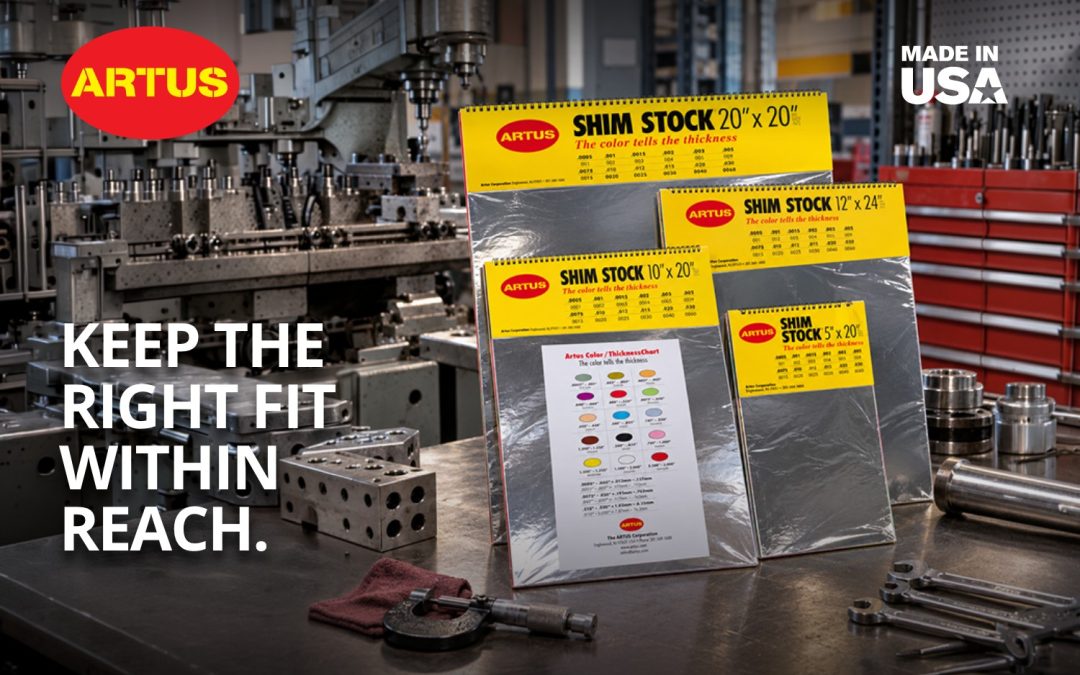
Artus offers color-coded aluminum shim stock, helping technicians quickly identify thicknesses and select the appropriate material for machinery adjustments, maintenance, and assembly.
Plastic shims are a lightweight, non-metallic option for applications where a non-marring material is preferred. Since plastic shim stock is impervious to oil, it is a great option for many industrial, machinery, and maintenance applications.
Artus color-coded plastic shim stock makes thickness identification easier, helping maintenance and assembly teams reduce selection errors, organize inventory, and work more efficiently.
Slotted shims feature an opening that allows them to be installed around an existing fastener in applications where removing the fastener completely is undesirable or impractical.
They can be especially useful for certain maintenance and alignment applications where installation access and speed matter.
Pre-cut shims are manufactured to specific shapes and dimensions and are ready to install.
They are particularly useful for:
-
- Repetitive maintenance procedures
- OEM equipment assembly
- High-volume production
- Standardized installations
For production environments, pre-cut shims can eliminate the time required to measure and cut shim stock during assembly.
Shim Kits vs. Individual Shims: Which Should You Buy?
The right purchasing approach depends on how your team uses shims.
Choose a Shim Kit When:
-
- Your team performs a variety of maintenance tasks
- Multiple thicknesses are commonly required
- You want commonly used sizes available in one package
- Different technicians need access to the same shim assortment
- You’re building or standardizing a maintenance inventory
Buy Individual Shims When:
-
- You already know the exact thickness and configuration required
- You have a recurring application
- You need a specific quantity
- You’re replenishing a commonly used size
Consider Shim Stock When:
-
- You need custom dimensions
- The application requires an unusual shape
- Standard pre-cut shims aren’t appropriate
- Your team regularly creates custom adjustments
For many industrial operations, the best approach is not choosing only one. A combination of shim kits, individual pre-cut shims, and shim stock can provide both speed and flexibility.
What Should You Look for in an Industrial Shim Kit?
Not every shim assortment is designed for the same purpose.
When selecting a kit, consider:
1. Thickness Range: The kit should include the thicknesses your team actually uses.
A broader assortment can be useful for general maintenance, while a focused kit may be more practical for a specific application.
2. Material: Choose a material based on the operating environment and application requirements.
Consider:
-
- Corrosion exposure
- Load
- Temperature
- Weight
- Surface compatibility
- Required durability
3. Shape and Configuration: Determine whether your applications require:
-
- Flat shims
- Slotted shims
- Washers
- Custom shapes
- Pre-cut profiles
4. Identification: Quick thickness identification can save time and reduce selection errors.
This is one reason color-coded shims can be particularly useful in maintenance environments.
5. Quantity: Consider how frequently your team uses each thickness and whether the kit provides enough material for the applications you perform.
Why Color-Coded Shims Can Improve Maintenance Efficiency
When technicians regularly work with multiple shim thicknesses, identifying the correct material quickly matters.
Artus color-coded shim stock uses color to identify thickness, allowing technicians familiar with the system to recognize the required thickness at a glance.
This can help:
-
- Speed up shim selection
- Reduce thickness identification errors
- Simplify inventory organization
- Improve consistency between technicians
- Make repeat adjustments easier
The color system becomes particularly useful when several thicknesses are stored together in a shim kit or maintenance inventory.
Instead of stopping to read every marking, technicians can quickly recognize the color associated with the required thickness.
Artus Color Thickness Chart
For Artus color-coded shims, the color tells the thickness.
The Color Thickness Chart provides a quick reference for identifying available color-coded thicknesses across Artus shim materials.
For example, Artus’ color-coded system includes thicknesses ranging from very thin shim material through heavier adjustment thicknesses, with colors assigned to specific thicknesses.

How to Use the Color Thickness Chart
When selecting an Artus color-coded shim:
1. Determine the required thickness.
Use the application’s specifications or an appropriate measurement tool.
2. Find the thickness on the Artus Color Thickness Chart.
3. Identify the corresponding color.
4. Select the appropriate shim from your inventory.
This simple system helps connect measurement → identification → selection, making shim selection faster for teams familiar with Artus products.
What Shims Are Used for Motor and Pump Alignment?
Motor and pump alignment is one of the most common applications for industrial shims.
Motor mount shims can be used to make vertical adjustments during alignment procedures and to address conditions such as soft foot.
The appropriate shim material, thickness, configuration, and installation method depend on the equipment and alignment procedure.
For maintenance teams performing recurring motor alignment work, keeping commonly used motor mount shim sizes available can reduce preparation time.
What Shims Are Used for General Machinery Alignment?
Machinery shims can help technicians make controlled adjustments to equipment positioning, spacing, and alignment.
Applications may include:
-
- Motors
- Pumps
- Gearboxes
- Machinery bases
- Equipment frames
- Production equipment
Because every machine and installation is different, the required shim thickness and installation method should be determined based on the equipment specifications and application.
Shim Kits for OEM Assembly
Shim kits aren’t only for maintenance departments.
OEMs and equipment manufacturers can use pre-cut shims during assembly when speed, repeatability, and quantity are important.
Instead of cutting shim stock during production, assembly teams can work with ready-to-install components manufactured to the required dimensions.
This can help:
-
- Reduce assembly time
- Improve consistency between units
- Reduce manual cutting
- Simplify production workflows
- Support repeatable assembly at scale
For OEM applications, custom pre-cut shims can also be manufactured to match specific equipment designs.
What About Custom Shim Kits?
Standard shim kits are useful for common applications, but some equipment requires a more specialized solution.
A custom shim kit can be designed around the specific requirements of an application, including:
-
- Required materials
- Thickness ranges
- Shapes
- Slots and holes
- Part dimensions
- Quantity requirements
Custom kits can be especially useful for OEMs, equipment manufacturers, and facilities with recurring specialized maintenance requirements.
How to Build a Useful Shim Inventory
A good shim inventory should reflect the work your team actually performs.
Start by reviewing:
What equipment do you maintain?
Identify the machinery that regularly requires alignment, leveling, spacing, or adjustment.
What thicknesses do you use most?
Review previous maintenance work and identify frequently used shim thicknesses.
Which materials are appropriate?
Determine whether your applications call for stainless steel, aluminum, plastic, or another material.
Which configurations save time?
If technicians frequently work around installed fasteners, for example, slotted shims may be more practical for certain applications.
What should be kept in kits?
Group commonly used thicknesses and configurations into an accessible assortment.
This turns shim purchasing from a reactive process into a more organized maintenance strategy.
Frequently Asked Questions About Shim Kits and Industrial Shims
Where can I buy reliable shim sets and kits online?
Artus offers industrial shims and shim solutions that can be purchased online, with quote support available for custom designs, larger quantities, and specialized requirements.
What should a machinery shim kit contain?
The contents should reflect the machinery and applications the kit will support. Common assortments may include multiple thicknesses, metal or plastic shims, pre-cut configurations, or slotted shims.
There is no universal kit that is appropriate for every machine.
What is the best material for industrial shims?
There is no single best material. Stainless steel, aluminum, plastic, and other materials each have properties that make them suitable for different applications.
Material selection should consider the environment, load, temperature, corrosion exposure, weight, and equipment requirements.
Are stainless steel shims better than aluminum shims?
Not necessarily. Stainless steel and aluminum offer different properties.
Stainless steel is commonly chosen for durability and corrosion resistance, while aluminum provides a lightweight, rust-free option.
The best choice depends on the application.
Are color-coded shims easier to use?
Color-coded shims can make thickness identification faster and help reduce selection errors. Artus uses a color-coded system for its shim stock so technicians familiar with the system can identify thicknesses quickly.
What are slotted shims used for?
Slotted shims are designed for applications where the shim needs to be positioned around an existing fastener. This configuration can simplify installation in certain maintenance and alignment situations.
Should I buy a shim kit or individual shims?
Choose a kit when you regularly need multiple thicknesses or want a range of commonly used shims available. Individual shims may be more appropriate when you already know the exact specification and quantity required.
Can I get a custom shim kit?
Yes. Custom shim kits can be configured around specific equipment or production requirements, including custom dimensions, materials, thicknesses, and quantities.
Choosing the Right Shim Supplier
When purchasing shims for machinery and industrial use, the product itself is only part of the decision.
Consider whether your supplier can support:
-
- Standard shim products
- Multiple materials
- Multiple thicknesses
- Pre-cut configurations
- Slotted shims
- Color-coded shim systems
- Custom designs
- OEM requirements
- Larger production quantities
- Online ordering
- Quote requests for specialized requirements
Having these options available allows the same supplier to support both routine maintenance needs and more specialized projects.
Why Choose Artus?
Artus Corporation provides shim kits and shims for machinery and industrial use, supporting maintenance teams, OEMs, equipment manufacturers, and industrial operations.
Artus offers solutions including:
Whether you need a standard assortment for your maintenance inventory, a specific shim for an alignment job, or a custom solution for equipment assembly, Artus can help you find the appropriate option.
Ready to Stock the Right Shims?
Don’t wait until a maintenance job or production project is held up by a missing shim.
Browse Artus shim products online to find standard shims, shim stock, and available packages for your operation.
Need a specific configuration, larger quantity, or custom design? For personalized assistance, call us at (201) 568-1000 or complete our RFQ form below.