
How to Choose the Right Tool for Accurate Machinery Alignment and Precision Measurements
Precision matters in industrial maintenance, equipment assembly, and machinery alignment. Whether you’re setting bearing clearances, checking gaps, aligning motors, or adjusting tooling, using the right measurement tool is essential for achieving accurate, repeatable results.
Among the most common tools used for precision measurement are feeler gauges, but they are only one part of a broader toolkit. Understanding when to use feeler gauges, shim stock, dial indicators, and other measurement tools helps technicians improve accuracy, reduce equipment wear, and minimize costly downtime.
What Is a Feeler Gauge?
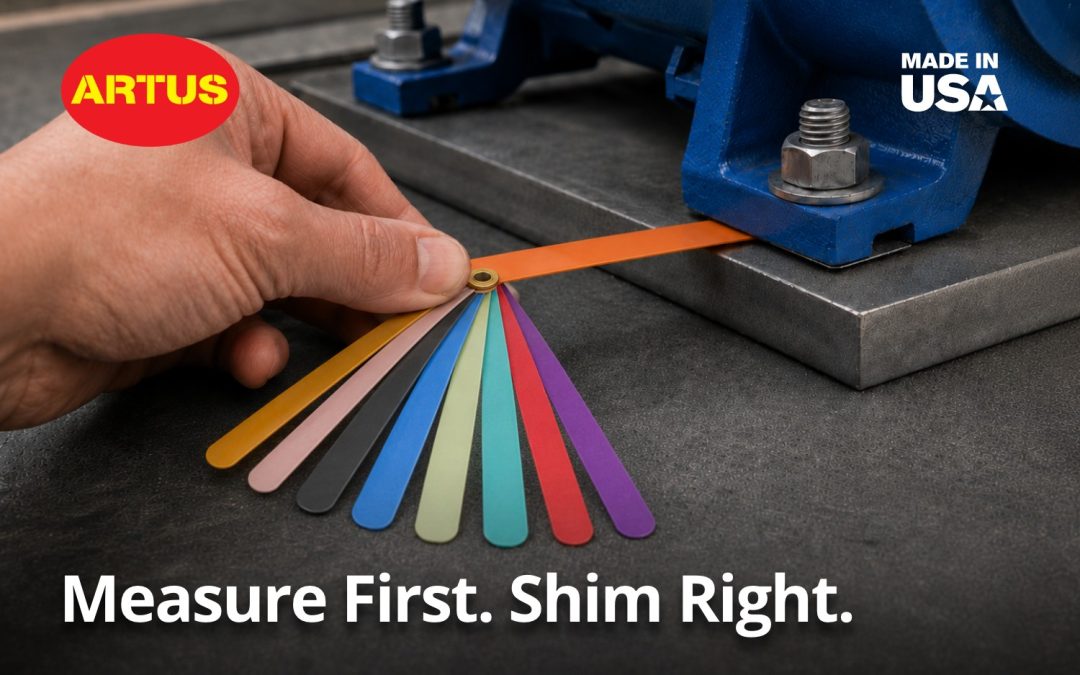
A feeler gauge is a precision measuring tool made up of thin metal blades, each manufactured to a specific thickness.
While traditional feeler gauges are most commonly manufactured from steel, plastic feeler gauges are also used in applications where non-marring, non-conductive, or corrosion-resistant materials are preferred. Artus manufactures plastic feeler gauges using its color-coded shim stock, allowing technicians to identify thickness instantly using the same familiar color system they already use for shim selection.
Technicians use feeler gauges to measure the gap or clearance between two surfaces where traditional measuring tools, such as rulers or calipers, cannot fit.
Common applications include:
-
- Motor alignment
- Bearing clearance checks
- Valve adjustments
- Machinery inspection
- Tooling setup
- Equipment maintenance
Because each blade has a known thickness, technicians can quickly determine the size of a gap by inserting one or more blades until the correct fit is achieved.
What Are Feeler Gauges Used For?
Feeler gauges are commonly used whenever precise clearances must be measured.
Typical industrial applications include:
-
- Measuring Mechanical Gaps: Determine the distance between two components before making an adjustment.
- Motor Alignment: Measure gaps during alignment procedures before selecting the appropriate shims.
- Equipment Inspection: Verify that machinery meets specified tolerances during maintenance or installation.
- Tooling Setup: Confirm proper spacing in tooling assemblies and manufacturing equipment.
Feeler Gauges vs. Shim Stock
Although they may appear similar, feeler gauges and shim stock serve different purposes.
|
Feeler Gauges |
Shim Stock |
|
Measures a gap |
Fills or adjusts a gap |
|
Temporary measuring tool |
Permanent spacing or alignment solution |
|
Used during inspection |
Used during assembly or maintenance |
|
Not intended to remain installed |
Designed to remain in place after installation |
A common workflow is to measure the required gap with a feeler gauge, then select the appropriate shim thickness to make the adjustment.
Understanding this distinction helps technicians choose the right tool for each step of the process.
The Advantage of Color-Coded Plastic Feeler Gauges
For technicians already using Artus Color-Coded Shim Stock, measuring gaps becomes even more efficient.
Because each plastic feeler gauge is manufactured from the same color-coded shim stock, the color immediately identifies the gauge thickness, eliminating the need to read small stamped markings on every blade.
Can Shim Stock Be Used as a Feeler Gauge?
This is one of the most common questions technicians ask.
While shim stock has a known thickness and can sometimes be used to estimate a gap, it is not designed to replace a feeler gauge.
Feeler gauges are manufactured specifically for precision measurement and are intended to be used repeatedly without being cut or permanently installed.
Shim stock is intended to remain in the equipment as part of the final adjustment or alignment.
Using each tool for its intended purpose improves both measurement accuracy and equipment reliability.
Other Common Measurement Tools Used in Machinery Alignment
Feeler gauges are often used alongside other precision tools.
-
- Dial Indicators: Measure movement, runout, and alignment with high accuracy.
- Laser Alignment Systems: Provide precise shaft alignment for motors, pumps, and rotating equipment.
- Calipers: Measure outside, inside, and depth dimensions of components.
- Micrometers: Provide highly accurate measurements of thickness and diameter.
- Straightedges: Help identify uneven surfaces or alignment issues during machinery installation.
Each tool has a specific purpose, and using them together helps create a more accurate alignment process.
Best Practices for Accurate Measurements
To achieve reliable results:
-
- Clean measuring surfaces before checking gaps.
- Use the smallest number of feeler gauge blades necessary.
- Measure before selecting shim thickness.
- Confirm measurements after adjustments are complete.
- Keep measurement tools clean and protected from damage.
- Record final measurements for future maintenance reference.
Accurate measurements lead to more consistent equipment performance and easier troubleshooting.
How Feeler Gauges and Shims Work Together
In many maintenance procedures, measurement and adjustment go hand in hand.
A typical process includes:
- Measure the gap using a feeler gauge.
- Determine the required correction.
- Select the appropriate shim thickness.
- Install the shim.
- Recheck the measurement to confirm the adjustment.
When using Artus Color-Coded Plastic Feeler Gauges, the transition from measuring to selecting the correct shim is even more seamless. Since the feeler gauge and the shim stock share the same color-coded thickness system, technicians can quickly identify the appropriate shim without cross-referencing measurements, helping speed up alignment and improve consistency.
Frequently Asked Questions
What thicknesses do feeler gauges come in?
Feeler gauges are available in a wide range of standardized thicknesses, allowing technicians to measure both very small and larger clearances. Multiple blades can be combined to measure intermediate gap sizes when needed.
Are feeler gauges accurate?
Yes. Precision feeler gauges are manufactured to tight tolerances and are widely used for machinery maintenance, inspection, and equipment setup.
What is the difference between a feeler gauge and a thickness gauge?
A feeler gauge is a type of thickness gauge specifically designed to measure gaps or clearances between two surfaces. The term “thickness gauge” can also refer to other tools used for measuring material thickness.
When should shim stock be used instead of a feeler gauge?
Use a feeler gauge to measure the gap. Use shim stock to fill or adjust the gap once the required thickness has been determined.
The Artus Corporation
Artus Corporation specializes in precision shim stock, pre-cut shims, motor mount shims, slotted shims, and color-coded shim systems that support accurate machinery alignment and equipment maintenance.
Once you’ve measured the gap, Artus provides the precision shim solutions needed to achieve reliable, repeatable adjustments across a wide range of industrial applications.
Order Online today. For personalized assistance, call us at (201) 568-1000 or complete our RFQ form below.